Tuesday, May 10, 2011

Highway Rhythms

(February 2011)    
     Relieved of its load of several tons of fabricated steel, the big Chevy flatbed seems to yawn and stretch as it leaves the restricted confines of the paper mill and heads out to open road.  The delivery complete and with time no longer of the essence, I decide to forgo the interstate and head home via  highway 99E, cutting through the farms and small villages that fill the Willamette Valley.  Turning off the radio, I consciously take a deep breath, holding it for several seconds before slowly letting it out  and allowing my shoulders to release any accumulated tension.  The tires on the wet asphalt intone a guttural, buddhist chant as my awareness drifts to the open fields.  
     It's a fairly typical Northwest winter day, where the moisture hangs in the air, not as rain, but a perpetual mist.  Little lakes form in low lying areas where the ground is thoroughly saturated and unable to absorb another drop.  I still marvel at the expansive fields of green - grass grown for its seed or a Winter cover crop.  The farms here make me think of a race horse, pressing against the gait, eager to run at the first hint of Spring weather.  I wonder how the owners of these farms are spending their "down" time.
     At the beginning stages of developing my own farm, I am some years away from being able to make a living by farming only.  My few acres require minimal care during the winter months.  With no animals to care for, there is little to do but plan and wait for warmer, dryer weather.  I am already following the trajectory of many established farm families - the wife works to provide a steady income while the husband farms and works part time jobs as needed to make ends meet.  My wife's (Denise) full-time work as a nurse is the financial backbone that makes the farm possible.  My goal for the farm is not only to provide our family with quality foods, but for farming to provide a living as well.  Big dreams, perhaps, but one I feel is achievable, and necessary.  I feel a sense of importance and urgency in this undertaking that I have never felt about any other job or previous projects that I've been a part of.
     Before the village of Shedd, I pass a sign indicating the location of the town cemetery.  The arrow points down a narrow lane which makes its way through  the middle of a field.  It seems appropriate somehow, that the road ends in the fields that are the focal point of the community.  My thoughts drift to more personal losses - my mother, aunts and uncles, school classmates.  The memories, while tinged with a sadness, give me clarity on the importance of living from my vision, and not being a pawn in the world dream.  Our time on this planet is short, no matter how long we live.  I don't want to waste my existence chasing the values of the mass culture only to come to my final moments with someone else's life passing before me and regretting the life not lived.
      I may not always be able to choose the road that lies before me, but I can choose how I travel it.

"On the highway of life, we most often recognize happiness out of the rear view mirror"
                                                                                - Frank Tyger


****************

(May 2011) 


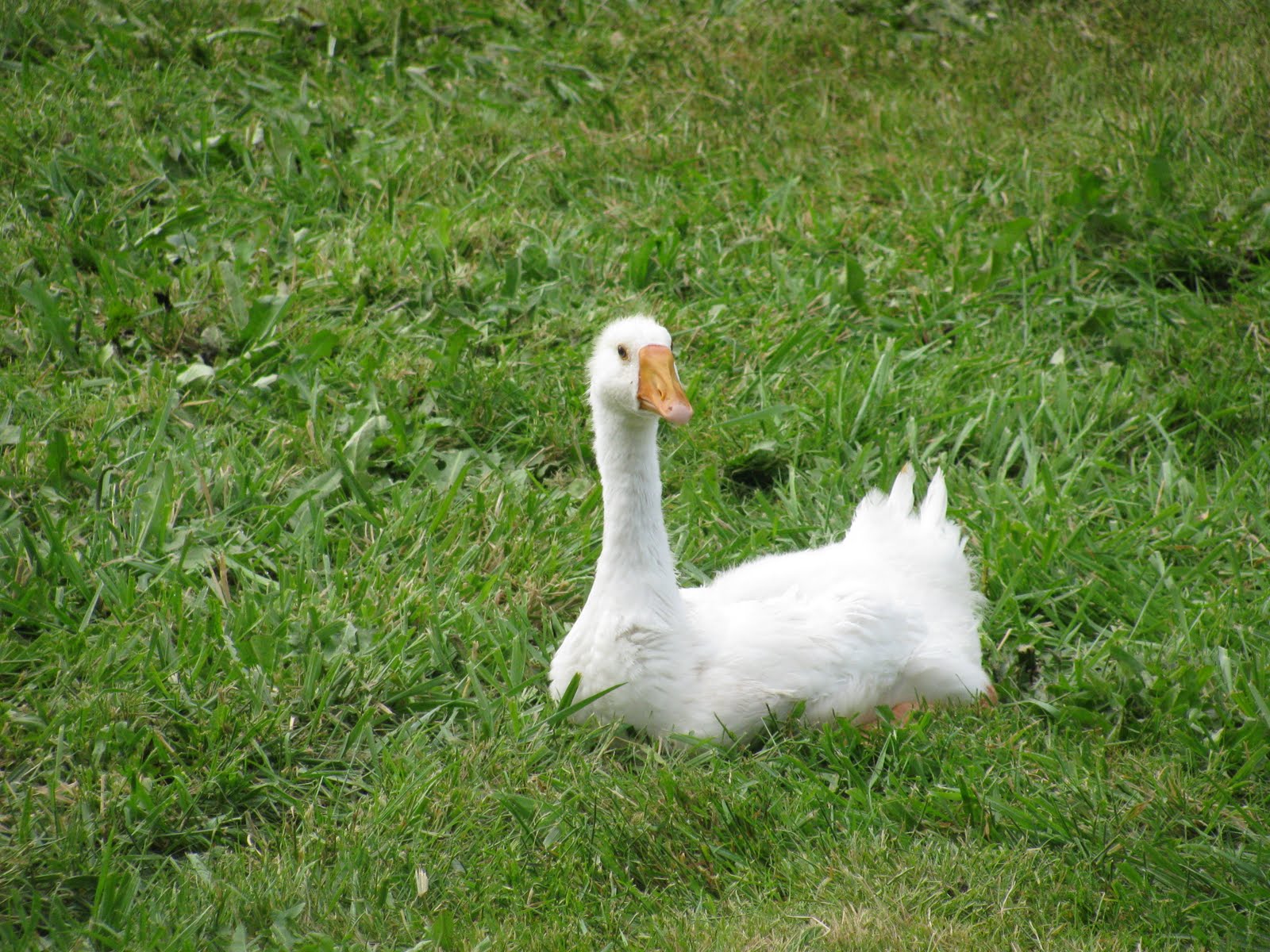
 New residents were added to the farm in April.  Ten Barred Rocks chicks and two Chinese Geese.  The residents began their stay in a large tupperware storage box in the house.  After adding another storage container after a week, it became necessary to build a bigger wooden box and move them all into the garage in order to salvage the air quality inside.  Due to their rapid growth, the large tupperware container came back into service to insure they had adequate space and weren't constantly pecking at each other.  Another three weeks and they'll be relocated to their permanent home in the orchard which has been fenced for their protection.
    The chickens are primarily for eggs, though theyare a dual breed (also good for meat) and will likely make their way to the pot when they stop laying.  The geese are to provide security for the hens.  (You don't want to make a goose angry!)

**********
The bees are buzzing.  I lost three of the seven hives I had going into winter.  The good news - one hive's growth has been so explosive that I had to add another super even after I created a split - taking out four frames that had larva (and queen cells) with honey and bees to start a new colony in one of the hives that had died out.  Hopefully we'll have enough warm dry weather over the next few weeks to allow the bees to forage and expand their colonies.
                    
                                                                                **********    
The transition from hobo to farmer continues as I switched jobs in April, leaving the highway behind to begin working for the Department of Agriculture as a commodity grader.  Having more of a set schedule will make it easier for me to plan and execute my farm duties.                                                                                              


Tuesday, February 8, 2011

Label Ire


     I'm a compulsive label reader and it may not be good for my health.  Let me explain.  The other day I received an email from my sister, Kathy, expressing her frustration at shopping in the supermarkets.  We share the same frustration and it's this:  it is getting more difficult to find real food in the aisles of most markets.   There is an increasing preponderance of food products on the store shelves these days, but less and less real food.  I read labels, not to figure calories, carbohydrates, protein or fiber content, but to see what the product is made of.  My supermarket reading selection usually annoys the hell out of me which can't be good for my blood pressure.  I must appear a lunatic, my glasses sitting atop my head(don't need them to read),  expletives bursting spontaneously from my mouth as I toss the offending item back onto its shelf and go grumbling down the aisles in search of the next likely offender.
     Try to find real ice cream, for example, and by that I mean the product made from milk, eggs, sugar (sucrose) and perhaps a flavoring or fruit.  My forays into the store to find this simple, basic product have proved to be a fools errand.  The first problem is corn syrup.  Now if you believe the ads paid for by the corn industry, who try to convince us that sugar is sugar - then as the old saying goes, I have some swamp land I'd like to sell you.  Scientific studies have shown that high fructose corn syrup increases weight gain, even when compared to taking the same amounts of table sugar(sucrose).  If you look at the rise in childhood diabetes in the last twenty years and the rise of the ubiquitous corn syrup in our processed food during the same period you  have to at least ponder the possibility of a connection.  But that's just the front end of my ice cream anxiety.    Corn syrup as a sweetener is certainly a terrible choice compared to table sugar as far as I'm concerned, but it's long list of other additives beyond the milk, eggs,  and salt also leave me shaking my head in wonder and disgust.  Xantham gum?  Used as a thickening and stabilizing agent it's also used in medicines to lower total cholesterol and blood sugar, but it may also cause bloating and flatulence and you may not want to have your blood sugar lowered (could be a problem for those recovering after a surgery).  Add to that list other ingredients such as dyes and artificial flavorings...my cart has been mostly devoid of this treat for several years.  The same is true of jams and jellies which I never buy from the store anymore.
    Breads often produce the same problem - riddled with additives you can't pronounce and that leave you guessing as to their purpose.  While I can find good breads from local bakeries, I've taken to baking my own.  An investment in a quality stand mixer has made my bread making almost embarrassingly simple and easy.  The smell of baking bread filling the house is alone worth the effort.  And tortillas...we're talking flour, salt, a little lard... shouldn't have a list of more than three or four ingredients.  See if you can find that short of a list on your grocer's shelf.  Fortunately tortillas  are about as simple an item to make as there is.  If you're spending the time to cook up a good chili verde, why wouldn't you spend the few extra minutes to have freshly made, warm tortillas to go with it?
     While time can be a limiting factor for many working families, making the effort to cook a meal with high quality, local ingredients is time well spent.  Cooking does require physical effort which may be difficult to muster  at the end of a hard day's labor, but the process is often more calming and restive that sitting in front of the television.  And good cooking does not have to be complicated.  The crock pot is a wonderful invention, allowing you to put together a great meal with a little prep time in the morning before your energy has been spent, and come home to a waiting meal. Your taste buds, your body, and your soul will appreciate the outcome.  
     I find the more I farm the more I want to do justice to the quality ingredients that I've worked to produce and so I enhance my cooking skills; and the more I expand my abilities in the kitchen the more I want to work with quality ingredients.  One feeds the other in a continuous loop.
     It all starts with one act - buying a cookbook, or growing tomatoes in a pot on your deck, or reading a label in a supermarket.    It's not important how you get there, it just matters that you start the journey of appreciating real food.  And whether you are a family of ten or one, don't you deserve the real deal?    
     

Monday, January 31, 2011

Reflection and Planning


      I'm not among the 45% of Americans who make New Year  resolutions, at least not in the traditional sense.  As a person who is vastly aware of his own ignorance, I find that I need to be in a continual state of reflection, evaluation, and planning in order to keep from being held hostage by that ignorance.  For me, setting smaller goals and then taking "bite size" steps, followed by outcome analysis and tweaking the plans accordingly is a more realistic scenario than setting  big goals at the beginning of the year that can't take into account the inevitable contextual changes that will occur.  Perhaps that's the hobo speaking, but I do believe that continual adaptation to the "is" is a better survival technique than a rigid goal set in a context of what you hope "will be".  Putting it in simpler hobo cowboy wisdom - "No matter where you ride to, there you are."
     The beginning of the new year, while not a time of resolutions for me, seems to be a good time for reflection.  This winter I've been pondering my own evolution to beekeeping and farming, wondering why this passion has crept up so late in my life.  There appears to be no straight line connecting the events that have brought me here, nor any single "aha" defining moment.  Farming is a state of consciousness I am gradually evolving into.
     Back in the mid 1980's, when I erroneously thought teaching might ease my restlessness and provide me with stability and a satisfying career, I attended Wayne State University in Detroit for a Masters Degree in teaching.   I did my student teaching at Chippewa Valley High School in Clinton Township, Michigan where I befriended an experienced teacher with over 25 years in the profession.  As I got to know him better, I discovered his first love was not teaching but farming.  He had inherited his family farm in central Michigan and spent his summers farming full time. During the school year he would fly his Cessna Skylane to work the farm on weekends.  He admitted that the farm lost money every year, but that his teaching salary allowed him to keep the losing enterprise alive.  I took what he was telling me at face value - he was doing something he loved in spite of the financial loss.  Most of us have hobbies that we spend money on, not expecting any  financial return - music, model trains, camping, quilting...  Thinking back now I realize I didn't really understand his commitment to farming.  I had no cultural context for understanding his devotion to that way of life.  Few in our modern industrial, high tech society can understand.
     Remember back to your childhood when you were so stoked with anticipation at Christmas of getting that "hoe, rake, and shovel" set that you could hardly breathe?  Or how you and your friends would play "cowboys and sod busters" for hours, often forgetting to come home on time for dinner.  And, remember as a teenager how you felt receiving your first baseball cap with the logo of your favorite seed or tractor company on it and how you couldn't wait to wear it to school with those new overalls and muck boots?
     No?...  Really?  No conversations with your high school guidance counselor about farming as a highly lucrative career and the need to take pre-farming classes at the local community college to make yourself more competitive for the crowded agricultural programs at the university?  Well, perhaps I'm being just a tad facetious, but hopefully with a point.  If you didn't grow up on a farm I imagine the likelihood of choosing farming as a full time career to be very small.  Even then, many farm kids, especially women, choose to seek alternative livelihoods far removed from their childhood experience.  How many people have you met whose goal is to work pre-sunrise to post-sunset, seven days a week?
     Don't get me wrong,  I'm not claiming long hours are my goal either.  But the more I  develop the few acres I have, the more it demands of me in sweat and time.  The peculiar thing is that I find great joy in being absorbed by the land at this time of life, where in my youth it would have been repellent.  Maybe I'm ready for the Geezer Ball - overalls and muck boots required attire.

~~~~~~~~~~~~~~~~~~~~~~~~~~~~~~~~~~~


     The weather hit the low 60's this past weekend which provided me the opportunity to dig into my hives.  I went into winter with seven hives, having lost the 8th to Colony Collapse Disorder last October, and unfortunately have lost three more.  The three loses are not due to CCD however.  One colony appears to have died due to starvation.  There was no honey to be found on any of the frames.  This is a little curious in that I left the hive two deeps full of honey and one medium which had several frames of honey going into the cold weather.  It is possible that the hive was weak to begin with and other hives robbed it of its honey.  Perhaps I should have reduced the entrance sooner to help prevent robbing.  I found frames filled with honey in the other two hives and so the bees should not have starved to death.  Their demise is a mystery to me.
    I cleaned the dead bees from the three hives and scraped away any burr comb.  All three have mold covering the frames (a result of the inactivity and not the cause) and supposedly when I relocate some bees from the thriving hives into those vacant hives, the new occupants will clean them up nicely.
    The warm weather left the four surviving hives literally buzzing with activity; the bees returning from foraging laden with pollen.  If the dry warming trend continues, I hope to be able to complete a more in depth inspection of the healthy hives in the next two weeks.

~~~~~~~~~~~~~~~~~~~~~~~~~~~~~~~~~~~


On the "To Do" list:
 * Cut down the row of pines on the south side of my fledgling orchard.  The trees are blocking much needed sunlight from the fruit trees, especially in early spring and late fall.

 * Build the chicken coop and buy and install fencing for same.

 * Build trellises and plant recently acquired old French grapevine cuttings.

 * Enjoy doing all the above. Celebrate accomplishments with home brew.

Tuesday, December 21, 2010

Hobo Origins: Lost in America Part II

Denise and I in Montana(circa 1974)
     I lay in bed in Petaluma, California, listening to the litany of dates being announced on the radio.  It was August 5, 1971 and I, along with my best friend Pete, were staying at the home of his aunt and uncle, as our journey hitchhiking through the West was ending.  The dates being selected randomly and broadcast over the airwaves held personal importance.  It was the lottery for the military draft.  The month and day of one's birth became a statistical horoscope of your near term future.  There was a war in need of young men.  With a draft number of 221, however, mandatory conscription and Vietnam were not in my future (though I enlisted several years later) and I was temporarily free to go about my life.
     Freedom from military service was not freedom from the war.    My generation were children of the war.  We grew up with Vietnam in our living rooms, its warriors, arsenal, and battlefields electronically painted across television screens, sharing the ether with the banal (Bonanza) and the extraordinary (moon landings).  Vietnam was an electric snake wound  around every neuron of the American psyche and which fed upon the very polarity it created.  Its psychic charge left little room for middle ground. It ionized the American consciousness with an air of black and white, right or wrong, for or against.  This polarizing current influenced art, politics, religion and served as the topic du jour for discussions held in big city diners and small town cafes.
     Perhaps nowhere was this more apparent than on college campuses.  Making a few runs at college during the early seventies, (University of Utah),   I found a dynamic energy where any and all topics were discussed and/or debated openly and earnestly, especially outside of class.  Here were people who read, wondered, and questioned as much as I did.  While attracted to this bohemian intellectual atmosphere, I was there without direction and the highway was constantly tugging at me, urging my return.  One quarter after finals, I loaded up the old Chevy Impala I had recently purchased for $150 and headed to Los Angeles.  After a couple weeks of visiting - including spending several nights camping in the freezing desert just north of Mexicali, Mexico, surviving the cold nights with the help of cheap tequila bought south of the border - the car's automatic transmission began to fail.  I traded the car for a flute, caught a cheap flight back to Salt Lake City and continued hoboing.  I worked roughnecking in Wyoming and Utah (drilling ventilation shafts rather than going for oil), as a gandy dancer(section hand) for the Denver and Rio grande Railroad, and working underground pulling copper and rail out of a defunct coal mine in Kenilworth, Utah.
     Work was interspersed with periods of jobless wandering.  I spent some months living in Los Angeles with my oldest sister, hanging out and experiencing people and situations far removed from the small town culture I grew up in.  There were a stew of characters - ex Black Panthers, acid poets,  political playwrights, students and ex cons -  all mingling in the same pot, an apartment a few blocks from Los Angeles City College.  Here the electric snake coiled tightly, ready to strike at the least provocation. I moved through this surreal cultural and political banquet as a tourist, tasting but not feasting on all its offerings.  There was nothing to anchor me here.
     Adventures came and went.  Time moved in fitful spurts, dizzying one minute, with the speed and volume of life moving so rapidly it was impossible to process in the moment; and possum like the next, when, in the illusion of youth, time stood still and all eternity lay as an ocean before me, its waves lapping lazily at my feet.
     Age teaches us that time is never static.  Moving at Mach I or contemplating a dew drop falling from a leaf  - time moves on.  And so it has with me; marriage, children, degrees, work...all changing the overt appearance of the hobo life to something more...traditional?  At first glance, perhaps.  While marriage  and children have been joyful, fulfilling experiences, I've never felt  any prolonged satisfaction  settling into a job or place until the farm concept began to take hold.  Pulling a honey super off a hive or seeing red worms in my compost bin create the same joy I used to feel  hitchhiking with the smell of sagebrush and asphalt in my nostrils.
     As we mature we also learn that, other than Texas Hold 'em, few things are all or nothing, black and white.  While farming stirs up a deep felt passion, I frequently lie  awake at night captivated by the call of a train whistle.  And though the feel of my hands deep in the soil is soothing to my soul, I still enjoy the pavement rushing beneath my feet as my wife and I head out on the motorcycle for a two hour ride or the rare multi-day tour.
     The hobo lesson is this: that we are all on a journey with a beginning and an end, and we travel unaware of  the joys and challenges that will face us along the way.  The best I can hope for is to say,  I travelled mindfully.


Monday, December 6, 2010

Hobo Origins: Lost in America Part I

     I remember staring out the window of Sister Justine's third grade class.  It wasn't that she was a bad teacher; she was a good teacher and I enjoyed her teaching.  But what was happening outside the school building was often more fascinating to me than the activities inside - unless it was geography class.  On a warm Spring day it didn't take much to draw my attention outdoors; the sound of an airplane engine droning overhead, the aria of a train whistle, or May's whispers of school ending and Summer's promise of untold adventures.  My wanderlust is hardwired, a part of my DNA.  I was forever wondering where the tracks, a road, or even the irrigation canal made their end.
     The tracks of the Denver & Rio Grande Railroad passed less than a hundred yards from my childhood front door; it's trestle a gateway  for the cars passing beneath it as they entered or left  town from the west.  As children we would hop a passing train on one side of the trestle, ride half the length of a football field, and jump off on the opposite side.  Good training for a hobo in waiting.  At night the rhythmic percussion of train wheels steadily lumbering their way along the track soothed my way to sleep.  By my senior year in high school I found that if I couldn't catch a ride hitchhiking home from Salt Lake, there was always a train going my direction not too far away.
     Just before graduation from high school in May of  '71, I, ironically, turned down a job as a brakeman with the railroad.  When graduation came, the plans I had made for a ride to San Francisco, where I would begin thumbing around California, were thwarted by a car accident and the ensuing financial obligations.  Jobs around the area were hard to come by and I ended up working in a migrant camp near Springville, Utah picking cherries with two friends, Pete and Gary.  Home became a two room wooden  shack of maybe 100 square feet.  We slept shoulder to shoulder on the floor in sleeping bags in one room; the other room was a "kitchen" consisting of a kerosene camp stove, a small wooden table whose finish had worn away many years earlier, and two chairs with barely enough room for as many people to sit in them.  One outside tap provided running water for the whole camp, and the bathroom was a community outhouse.   It was typical that whole families worked together to earn a living.  Little children would even gather cherries from the ground and pick low hanging limbs.  The living conditions didn't bother me.  What was a concern was my lack of skill at picking. Earning 4 cents a pound and on my best day only able to pick around 180 lbs.,  it soon became obvious that after I paid for food, I wasn't making any money.  After four or five weeks of working to just barely provide enough to eat, I gathered my belongings and about eighteen dollars and took to the highway with Pete, who was picking less than I was.  The initial plan was to seek work in Wyoming or Montana where I had relatives in Livingston and Butte.
     That trip lingers in me still.  In Wyoming an old timer picked us up, looked at our backpacks and figured we were heading into the wilderness.  Despite our explanations of how we were just hitchhiking and not really hiking, and in his earnestness to help two young explorers  he took us off the main highway leading to Jackson Hole, past the town of Moose, and dropped us off ten miles from any  travelled thoroughfare. Though the next next morning brought on a long hike back to a road with any traffic, that night premiered stars larger and more numerous than any I can remember.  The same could also be said of the local mosquito population.  In Livingston, Montana we helped my aunt and uncle slaughter and process chickens raised without hormones and antibiotics on their small two acre farm.    They refused to eat store bought chickens long before "organic" was cool.
     At the job service in Livingston, we found little encouragement for finding jobs anywhere in the area and so decided to just follow the road to see where it would take us.  We stopped briefly in Butte to visit another aunt and uncle before making our way through Northern Idaho, Southeast Washington and then to Oregon.  Along the Columbia we saw tugs maneuvering barges that my desert, landlocked eyes first mistook for islands.  In Portland we spent the night in the weeds at a defunct gas station at the crossroads of East/West bound I-84 and north/south bound I-5.
     South of Portland we caught a ride with a rather amiable fellow named Tam.  Tam, who I remember as being around his late thirties to early forties, had recently moved to Oregon from the Midwest and was living with his brother who was a commercial fisherman.  It was the off season for his brother and they were making residence  at the Ten Mile boat camp near Coos Bay. We found his brother's family as warm and open as he was.  For no good reason I could think of, they brought us into their home, fed us  smoked salmon and Blatz Beer for appetizers, and then cooked up fresh sturgeon for dinner.  With our bellies full and the summer light fading, Tam guided us into the local sand dunes  for a good spot to camp and then disappeared.  Pete and I had a good beer buzz going and were sure we would never be able to find our way out of the dunes come morning.  As we were about to settle in, Tam reappeared with about a dozen kids around our age, each bearing beer or wine.

     It was around this point that several remarkable things happened.  We lost the sense of time.  Neither Pete nor I were sure whether it was July or August.  We had no watches, and really cared less about the arbitrary numbers of the clock.  We got up with the sun and slept when it got dark or we were tired.  We began to travel without any grand plan of where we were going, how long we would stay anywhere or what we would end up doing.  We lived in the present moment.
     We had little money when we began our journey.  After spending about a quarter of our funds the first few days on a hamburger in Jackson Hole, Wyoming, we quickly figured out we would have to be much more frugal if the trip was going to last more than a week.  For the two months we were on the road, we thrived mostly on bread and peanut butter, which made the generosity of our fisherman family all the more precious.  Somewhere along highway 101 in Northern California, we spent the last of our funds on one shared cup of coffee at a Denny's Restaurant.  We were literally penniless.  Far from experiencing any fear or consternation due to our financial lack, we found ourselves joyful and content, living without need or want.
     The trip came to a quasi end in Petaluma, California where our forward motion finally came to a rest.  Pete had an aunt and uncle he hadn't seen in years living in the area and we decided to visit.  His aunt was eager to have us stay and encouraged her sons to help find us jobs.  One of Pete's cousins got me on as a painters assistant where he worked. (One of the few things worse than painting, for me, is prepping for painting.)  Pete went to work as a personal orderly for an older paraplegic gentleman who another cousin cared for. He found that he liked that type of work - caring for people who had difficulty caring for them selves. (As an aside - when it came time for him to administer his first shot to the old gentleman, Pete's only frame of reference was witnessing my Uncle Frank in Livingston give a shot to a horse - holding the syringe between thumb and forefinger and then gently slapping its hind end with the back of the other three fingers two or three times before hitting it with the needle, so as not to startle it.  I can only guess at the old guy's confusion on receiving his medication in this manner.)
     Pete decided to stay with his relatives and see where his new job would take him.  I found there was still had a stretch of highway before me, leading me back to Utah.  In another series of cosmic coincidences I also found a job as an orderly, working at the local nursing home in my hometown of Price.  Less than four months later Pete would return home to take the orderly job I was vacating to lose myself in America once again.
     A Hobo Koan:  What is the magic in the sound of tires traveling the highway on a moonlit night?


Tuesday, November 23, 2010

The Dying of the Light


...Wild men who caught and sang the sun in flight,
And learn, too late, they grieved it on its way,
Do not go gentle into that good night.
                                      -  Dylan Thomas


     I know of those for whom the anticipation of snow piled high brings a childlike glee to the center of their being. They have already begun to liberate skis and snowboards from exile, out of desolate basement corners and seldom visited closets.  They tell tales when gathered with other winter enthusiasts, blowing dust off last year's remembrances of shushing down mountain runs with quizzical names such as "Galloping Goose" and "Flying Squirrel".  Then there are those who prefer a higher octane version of frosty revelling, thundering their way though the forest on snowmobiles, their machines vibrating their riders to a state of frozen bliss.  
     There is nothing in those scenes that appeal to my solar powered heart.  I know that Dylan Thomas was not talking about sunlight and nighttime per se in "Go not gentle into that good night", but he could have been.  Death is foreshadowed in the long Winter nights.  Or, at least, if not permanent death, then a temporary other -  a  psychic hibernation.  Where others skate and slide their way to the Winter Solstice, I trudge.
      It must be admitted to here that I am in mourning, and the seasonal chill blowing through me is amplified by loss.  The last day of this year's outdoor Farmer's Market was last Saturday.  I was there to send it off, to pay it homage and lament its passing.  Gone is my weekly ritual celebration of a community's amity and altruism, the festive crowds.  Gone is my summary entertainment of people watching.  Gone is the  chorus of family farming that urges me along my path.  Gone.
     Before you call 911 on my behalf - I know it's a temporary situation.  I grasp that April will return, carrying with her the things I love.  I get that.  Really.  Still, there is an emotional retreat.
But that's not necessarily all bad, either.  If I am conscious of my state of being I can redirect my energies to intellectually creative and productive endeavors.  There is real planning to do;  figuring out what resources I have and where best to allocate them.  Next Spring there will be chickens and pigs on Lost Road Farm, along with expansion of the apiary.  Perhaps I'll plant a few more apple trees.  I found a resource that offers Sunday workshops in organic farming starting in January.  They're reasonably priced and I don't have to worry about scheduling conflicts.  Immersing myself in the necessary intellectual undertakings of farming, eases my emotional loss and brings the light of hope.

     The garden, too, has put on it's winter face.  While the tomatoes have succumbed to the colder weather, the greens have continued to do well.  My collard greens are larger and thicker now than they were in the warmth of summer.  The one dill plant that went to seed in late summer, is now a miniature forest filling half the raised bed.
     Creative activities such as cooking and brewing also offer recipes to mitigate winter's chill.  In two weeks I bottle my Espresso Oatmeal Stout.  (I'm already contemplating an Imperial Chocolate Stout).  Dishes such as Chile Verde, Chicken and Dumplings, or a Basque Lamb Stew are made more appetizing  with the chilly weather.  Paired with the right homemade brew they make winter almost desirable.
     Yes, there is a place where people gather to share the warmth and good wishes of the season; to share food, drink and conversation with friends and family.  That place is called Hawaii and those people will be wearing T-shirts and shorts.  The weather forecast for Koloa, Kauai is a high of 79 and low of 71.  All week.  And next week.  And the the week after that...Aloha.
      

Tuesday, November 16, 2010

Seeds of Imperfection

     The Navajo are renowned for their work on the loom.  Scrutinize any weaving from a Navajo artisan and you're bound to swear the work is perfect.  But you'd be wrong.  It will only be nearly perfect, because each weaver intentionally places an imperfection, called a "spirit string", in each piece.  The spirit string serves two purposes.  First, because they put so much of their soul into their work, they leave a loose string so their spirit can find a way out of the weaving and not be trapped in it.  Second, they believe the things of man cannot be perfect and  take ownership of the imperfection, weaving it consciously into their work so they know where it is.
     I confess I am the inverse of a Navajo weaving.  I am a tapestry of flaws and shortcomings, with failings too numerous to enumerate (but that hasn't stopped anyone from trying).  Label me a misanthropic malcontent who has found it difficult to reconcile my personal values with the commonly accepted goals and motivations that are the basis for living in this culture - especially in the area of employment.  Curious and philosophically unsettled, the hobo way manifest itself early in my youth where, after my release from my high school sentence, I began hopping trains: finding work in a migrant camp picking cherries in Springville, Utah, roughnecking in Utah and Wyoming, working section on the railroad in Helper, Utah, planting trees in the mountains  around Telluride, Colorado, working as a painter's assistant in Petaluma, California.  As I got older, jobs took on a more "professional" air and I found work as a teacher, nurse, sales manager, marketing director [this is a much abbreviated list] - but still moving from one job to the next, finding little satisfaction in any of them for very long.  Restless and lacking financial stability, I am any spouse's nightmare -  imperfection personified.
      There is another side to imperfection, however.  Coming to terms with man's, nature's, and/or our own deficiencies can be a driving force for change and an impetus for creating.  As I mentioned in an earlier blog, it was the realization of the failings of the industrialized food system on the macro level and a bust pumpkin crop on the micro level that awakened my desire to explore sustainable agricultural practices and to create a small working apiary and farm.  My own social flaws make me an ideal candidate for farming.  It fits my introverted personality, allowing me to work without being surrounded by the noise of others and to joyfully focus on the job at hand.
     Don't misunderstand me.  I enjoy the company of others; the gathering of the Farmer's Market or sharing a well prepared meal with friends.  But I seldom seek a crowd just for the sake of  being around people.  I'm not one to have the television or radio on in the background when I'm alone.  I'm often alone but rarely lonely.
     The land too is "imperfect" in the context of growing crops other than grass, so I compost the soil to enrich it.  I plan on putting pigs on a section of the farm this coming spring that I want to plant the following Spring.  The pigs will "roto-till" the soil, eating the grass and plants that currently grow on it, while working in their droppings, providing a premium organic compost as they go about their business. Imperfection is not failure.  It is contextual and temporal.
     It's counter intuitive that all these forces of imperfection should coalesce to generate something of greater value than their flawed individual parts, but it is true, nonetheless.  The farm for me is a spirit string that allows me an escape from my imperfect weavings.  I find some personal redemption in that.

~~~~~~~~~~~~~~~~~~~~~~~~~~~~~~~

My friend Pat enjoying the grueling work of brewing
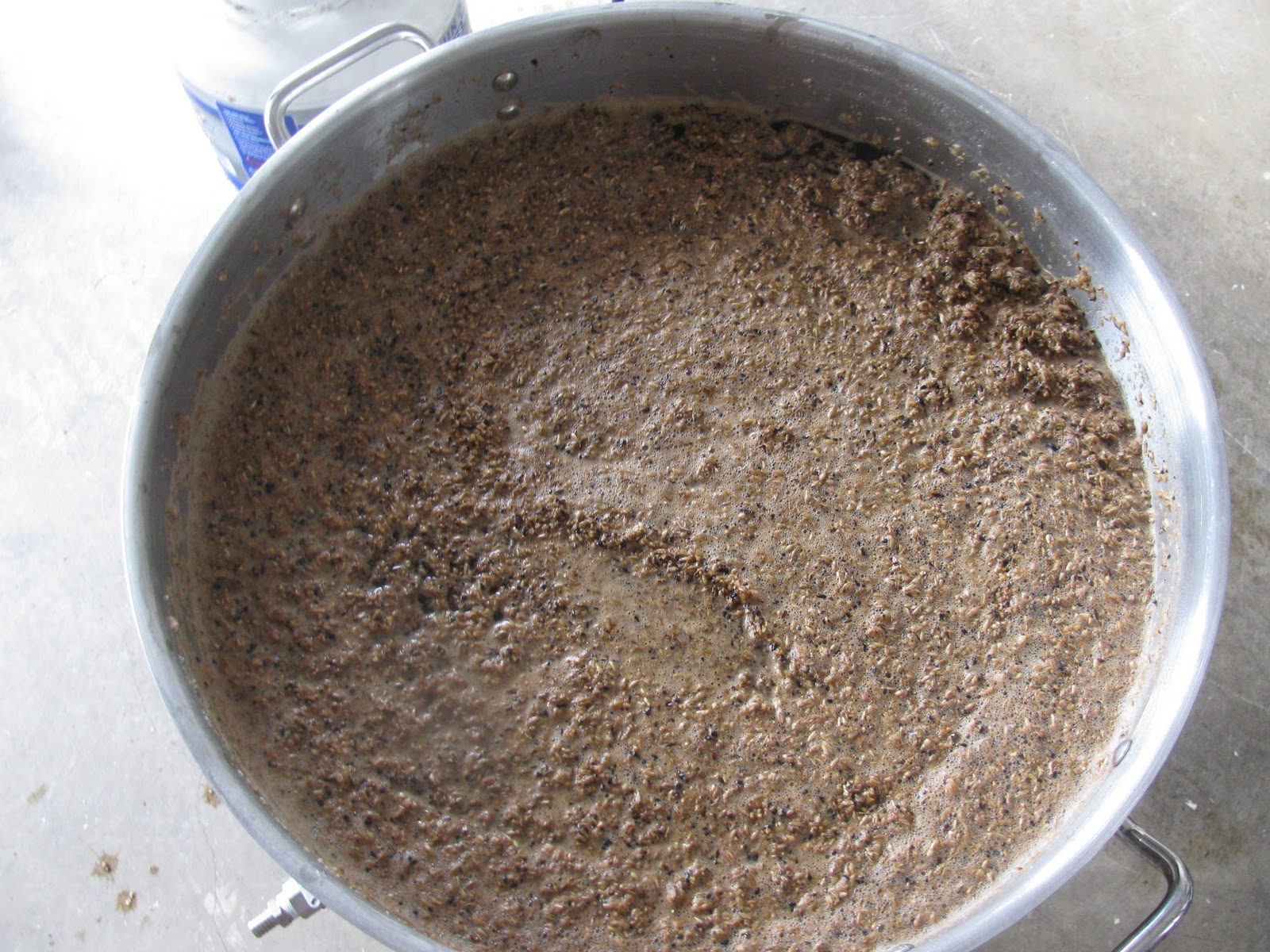
the mash


      Winter is a great time for brewing.  With the weather gray and cool and the outdoor work load reduced, brewing provides a creative activity with which to occupy oneself.  I spent the greater part of this past Sunday in the garage brewing a 15 gallon batch of Oatmeal Espresso Stout with the help of my friend Pat.  I even worked in two pounds of honey into the recipe, giving my bees a part of the process.  As I write this, I can hear the sound of CO2 bubbling through the airlocks on the fermentors as the yeast converts the sugars to alcohol.  If there are any all grain homebrewers who would like the recipe, you can email me at: lostroadfarm@yahoo.com.  I would be happy to share the recipe with you.